I'm rolling out an AI disclosure to my emails and published writing:
e.g. AI score: 90% me / 10% AI
The percentages are my best estimate of how the writing was created:
100% me / 0% AI: I typed everything myself with zero AI input.
90% me / 10% AI: I wrote it. AI helped with cleanup or minor edits.
50% me / 50% AI: AI and I both substantially shaped it.
10% me / 90% AI: AI created most of it. I directed or edited it.
0% me / 100% AI: AI generated it from a prompt, and I published it without editing.
The score describes the writing process, not whether the ideas are true, valuable, or genuinely mine.
It is an honest estimate, not a scientific measurement. I may not share the prompt or name the specific AI tool.
For example, this blog post : 90% AI / 10% me.
The prompt that created it (stream of consciousness voice-to-text):
I'd like to create a quick, very readable, as short as humanly possible blog post explaining my practices around AI disclosure in my writing and my email. I want it to be basically everything that I do. I'll give an AI score, like, "This is like 90% AI, 10% me," or "90% me, 10% AI for cleanup." It's 50/50, or 100% me means that I typed the entire thing with my fingers on a keyboard and zero AI inputs. A 100% score would mean that I just generated it with a prompt and didn't edit it at all, and that you don't have access to the prompt or that Gemini suggested it.
I'll just put my AI score at the bottom of every email that I send, with a link to the blog post explaining what I mean. I just want a really clear, readable format for it that is kind of self-explanatory and easy to produce.
Passive Exhale?
We’ve been told our whole lives to “blow” and “strong sustained air” and “support” and all that.
What if that's wrong?
Or at least, what if there’s something immeasurably valuable to learn from using completely passive air?
What makes it passive?
Not using any force or muscles to “push” the air.
Passive air is zero-engagement air.
It’s the equivalent of a sigh.
Gravity does the work.
Next time you pay horn try it.
Take your breath, and see if you can let it flow out of you with zero attempt to control.
Let the natural resistance of the buzz control the release of air.
Notice how it feels and what you can learn 🙂 Especially as you ascend...
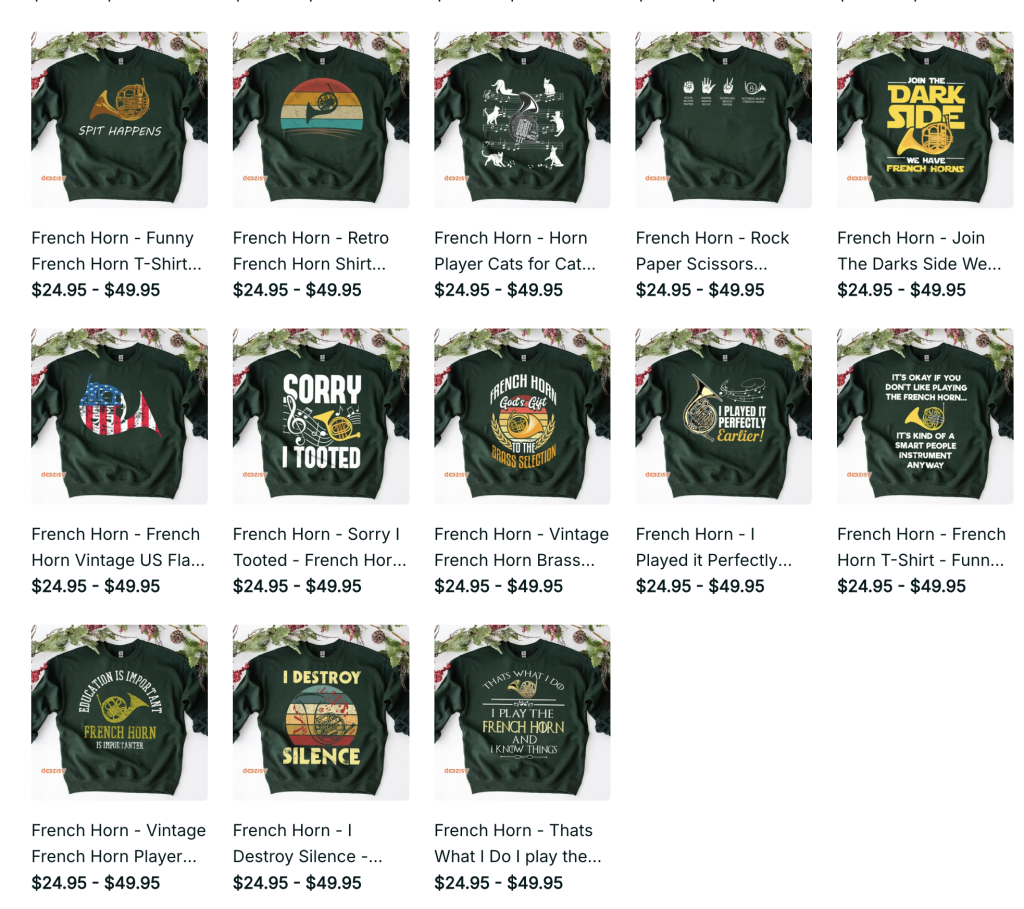
French Horn Holiday Stocking Stuffer Guide
Here's some of my favorite gear, music, and online stuff you can gift yourself or a special French horn player in your life.
I even worked with a few vendors to get you discount codes!
Invented by Metropolitan Opera hornist Barb Jostlein, this takes the pencil clip to the next level. Used and loved by pro players, both for the satisfying snap of the magnet, and for the fact that this won't harm or scratch your horn like a typical pencil clip.
We get to offer these at High Range Magic because a percentage of folks who take the consults choose to work more closely with us. But everybody who gets a consult gets strategy, insight, and free resources to take their playing to the next level. We love it!
Happy Holidays y'all - stay safe, happy, and free of clams...
Low Horn / Roll Out Training Video
I've been using & elaborating on the "roll out" concept from Jeff Smiley's Balanced Embouchure for YEARS, to play well below "fundamental C" on the horn.
Not only is this useful for opening the low register, there are a number of benefits to roll out practice:
Make you more efficient & enduring in the high range
Sensitize you to important leadpipe angle subtletites
In my decades of playing horn (and dabbling in trumpet and trombone), I've been a voracious explorer of different approaches.
Many books have given me one or two nuggets.
Others have led me down not-so-helpful paths (Farkas "Art of Horn Playing" gave me a lot of good stuff in high school, but also indoctrinated me into flat chin static embouchure misery for many years)
Methods that I would genuinely recommend (in no particular order) at this stage in my journey, are as follows.
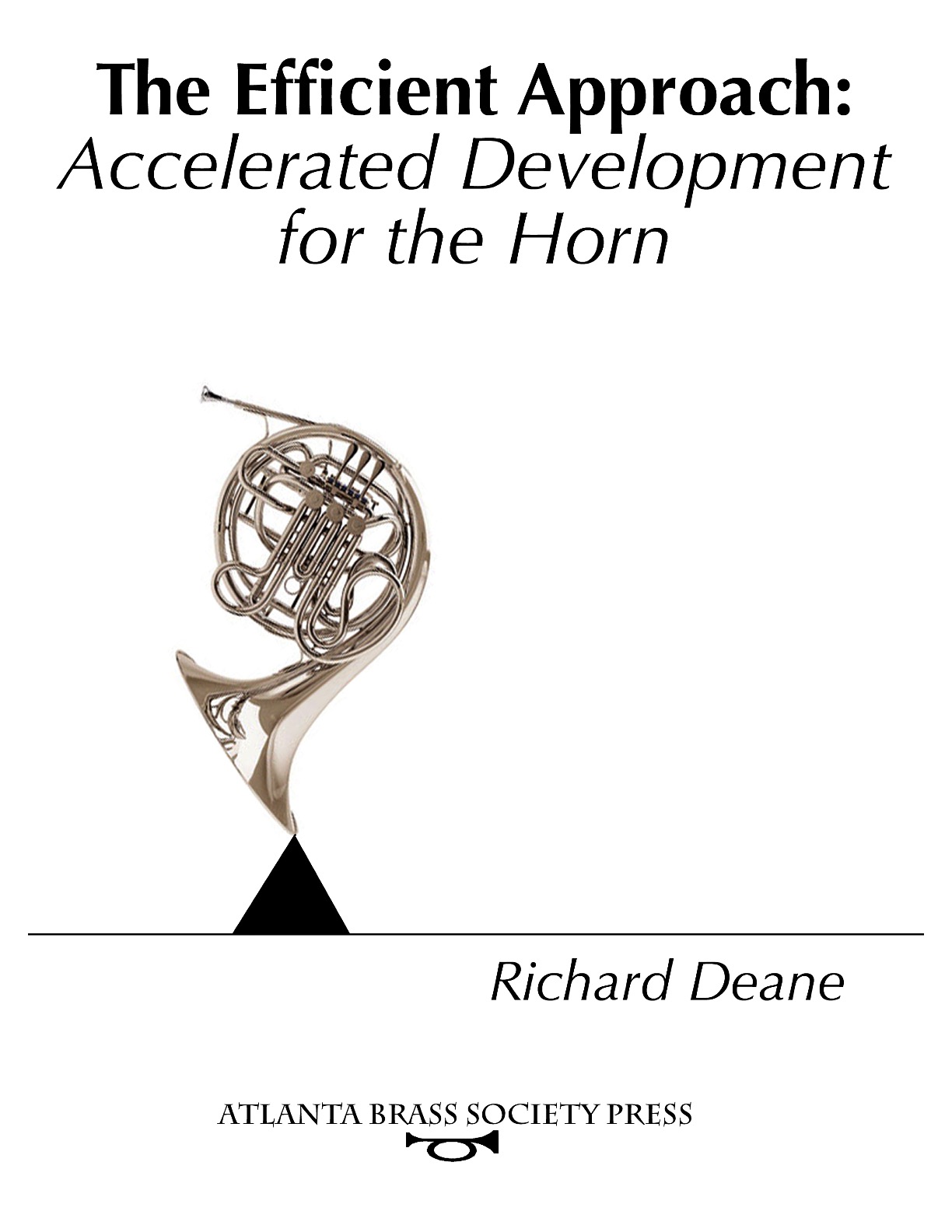
Richard Deane's "The Efficient Approach" is a masterful and modern book of wisdom about horn playing. He provides a lot of ideas that helped me, as well as a very well-rounded warmup.
The utterly inimitable Julie Landsman, former principal horn of Metropolitan Opera, created an amazing video series along with sheet music and a practice calendar, for her interpretation of the Caruso Method.
I studied this with Julie and have found great benefit from practicing these exercises. Listening to her talk through and demonstrate the exercises is far more rich than reading from a book.
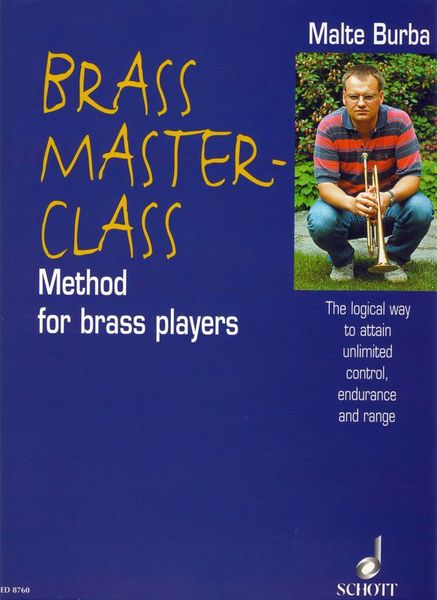
Malte Burba is an absolutely masterful performer and pedagogue, and I believe he truly understands how to create an easy, powerful, joyful, reliable approach to the instrument.
When I read his book I had a bunch of lightbulb moments and also a bunch of "GAHHH I KNEW THIS WAS TRUE HOW COME NOBODY ELSE SAYS THIS".
But I am incredibly proud of the method that I put together for brass players to truly understand and master not just the high range, but their practice habits, mindset, relaxation, and musical integration.
I don't know any other brass methods that talk about the role of emotion and mindset in results, but it's a HUGE component of what happens when we pick up the instrument.
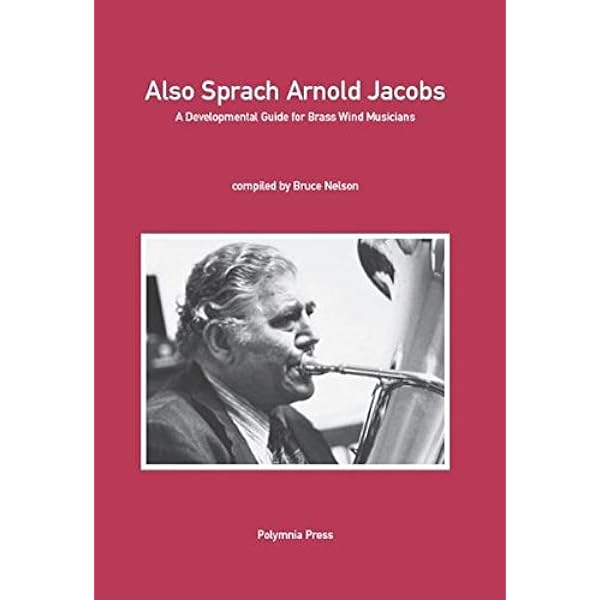
I would not feel complete if I did not recommend this Arnold Jacobs wisdom compendium!
Arnold Jacob's legacy of teaching and thought-leadership was a huge contribution to the brass world.
If you have not purchased and read his book, I strongly recommend it.
Though it's not a "method book" per se, it has little nuggets of wisdom and is readable in small chunks. For years I would spend 2 minutes per day reading this as part of my practice routine. Always worth it.
The OG place to buy it is Windsong Press which has lots of great breathing devices and such too (stock up!). Or you can get it on Amazon.
Learn to Circular Breathe - live masterclass
French horn high range research - survey results
So we did a thing!
183 horn players from the facebook "Horn People" group, filled out a survey about their relationship with high register playing.
Let's dive in...
Who took the survey
This was optionally anonymous, but enough folks identified themselves that I can say for sure we have a range from top professionals (e.g. NY Metropolitan Opera) to college students, adult amateurs, and even total beginners.
94% the players have been playing at least 5 years.
80% have played at least 10 years.
And almost half (45%) have played 20+ years.
So, put simply, these folks have had a chance to figure out how to play high.
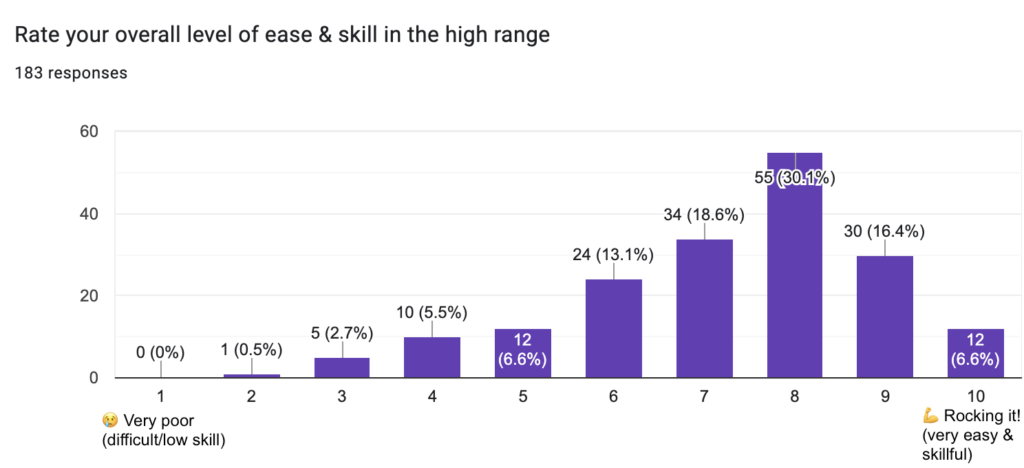
And, gladly, the most common answer for “1-10 Overall level of ease & skill in high register” was an 8/10, so pretty good.
85% of players are above average?
In fact, 85.2% of players ranked between a 6 and a 10 on this scale.
Only 14.8% of players ranked a 5 or below.
But interestingly, you might expect more of a normal curve here.
It reminds me of the finding that more than 50% of people rank themselves as “above average intelligence”.
"On a scale of one to 10, you probably think you're a seven. And you wouldn't be alone."
65% of Americans, according to this study, believe they are above average intelligence.
So that’s probably in play.
If you ranked yourself an 8 in this survey, are you really an 8 in the grand scheme of what’s possible?
If I had put measurable metrics here, that might have skewed things.
QUESTION: What are the real endpoints here?
For me, a 10/10 means you can play a 4 octave arpeggio up to F above high C....
or maybe playing Siegfried Long Call up a 4th, 3x through without endurance issues.
(I should make a video of this, to prove the point, or nobody will believe me...)
Highest comfortable notes
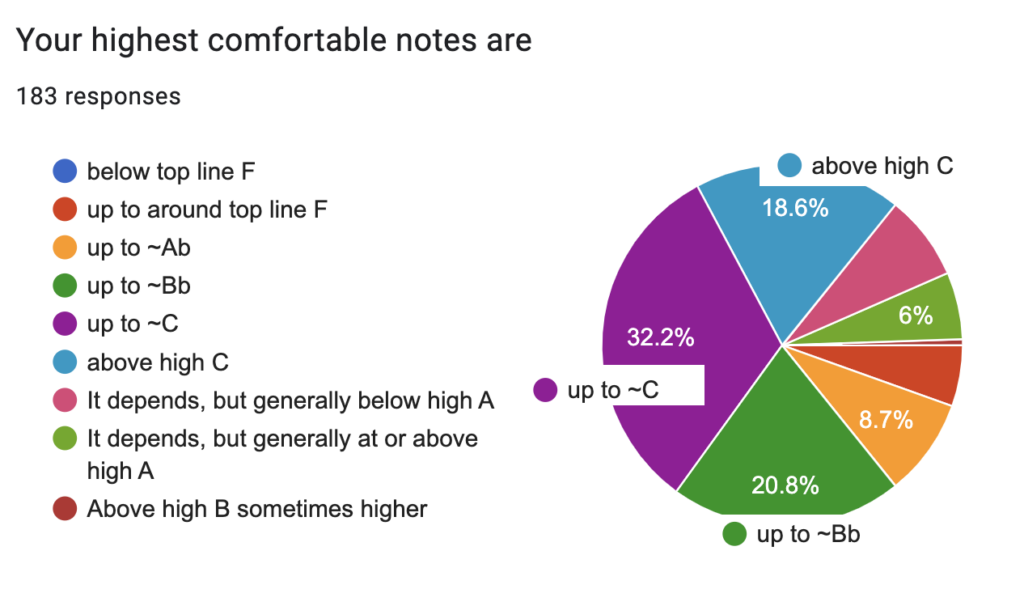
This is cool. So 50.8% of players have a high C and beyond, that's great!
On the low end, 5% of respondents said up to around top line F.
Again, I suspect this might be a little skewed, depends on definition of comfort.
French horn high range: highest comfortable notes
Based on my real world experience, there are probably 1/3 to 1/2 of all players who have "figured out" the keys to playing high.
And that makes high C and above relatively accessible for them.
Then there are the other 50%.
These are the folks who struggle to get up to high C. Some max out around A, Ab, Bb, etc... All have something in common: high C is not considered a comfortable note.
[Spoiler alert & shameless plug: nobody needs to live in a reality where they can't comfortably play high C. If you're a brass player who wants help with that, reach out].
Daily Effort in High Practice
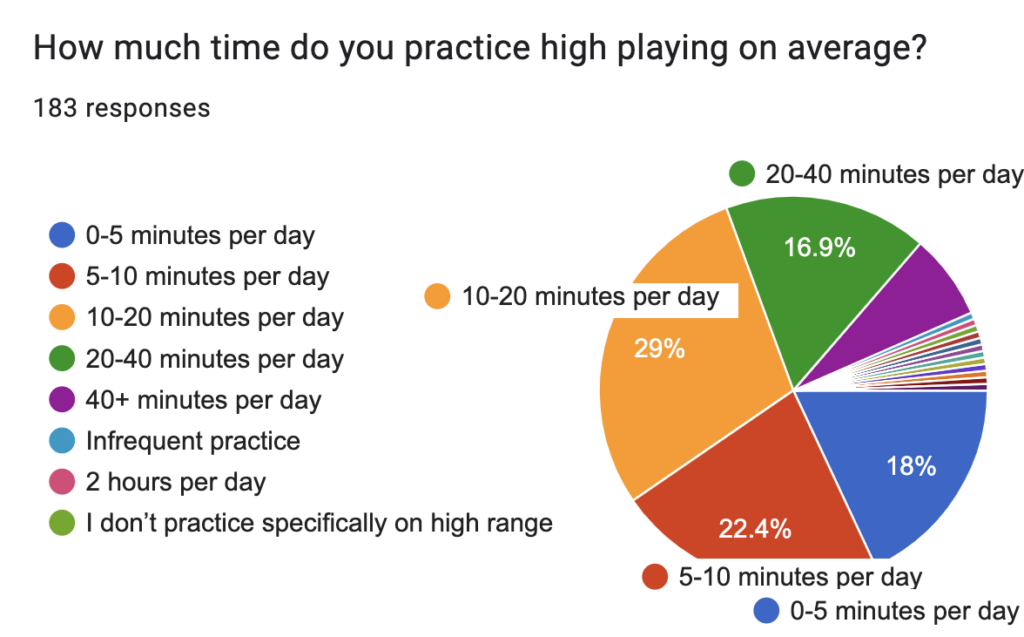
Here I found that nearly half (45.9%) of respondents practice 10+ minutes a day on high range.
I should have clarified that this means deliberate practice to improve your high playing, not just "ok now I'm practicing music that happens to include some high notes"
I love looking at this breakdown. It really tells a story....
And there were a number of "other" responses, captured here:
Only when practicing for a gig
No specific difference between high playing and regular playing. If I feel tight, I tend to try sitting in the upper register.
Infrequent practice
I practice 2-3 hrs per day, across all registers.
I don’t really set aside time to just practice high or low playing anymore
I don’t practice specifically on high range
As needed
An hour or more but not every day
Case Study
The (anonymous) person who said "I don't really set aside time to just practice high or low playing anymore" has the following attributes:
Played 20+ years
Range above high C
Overall level of skill: 9/10
This is as it should be.
When you figure out how to play high, you really don't need to practice it much if you don't want to.
For example, I personally do 2-5min of deliberate high range practice about 3 days/week, which keeps me able to play easy strong F above high C and slowly working towards a clear double C.
"2-5min of deliberate high range practice, ~3 days/week.
This maintains strong F above high C, working towards double C"
- MARS GELFO
I actually think that practicing high range exercises for 40+ minutes a day is crazy.
That's based on my own experience trying to build my high register as if I was building my bench press.
News flash folks!
Playing a great high C is not like training to bench press twice your body weight.
It's more like learning to run with good form, in a few ways actually:
Most of us can naturally run with good form
....But constricting shoes, desk jobs, and lack of physical awareness often lead to terrible running form
....Which leads to injuries and difficulty
All you need to do is learn the correct range of movement, listen to your body
And you can run, sprint, ultramarathon, etc. without much issue.
Once you have great form, endurance and strength stop being concerns.
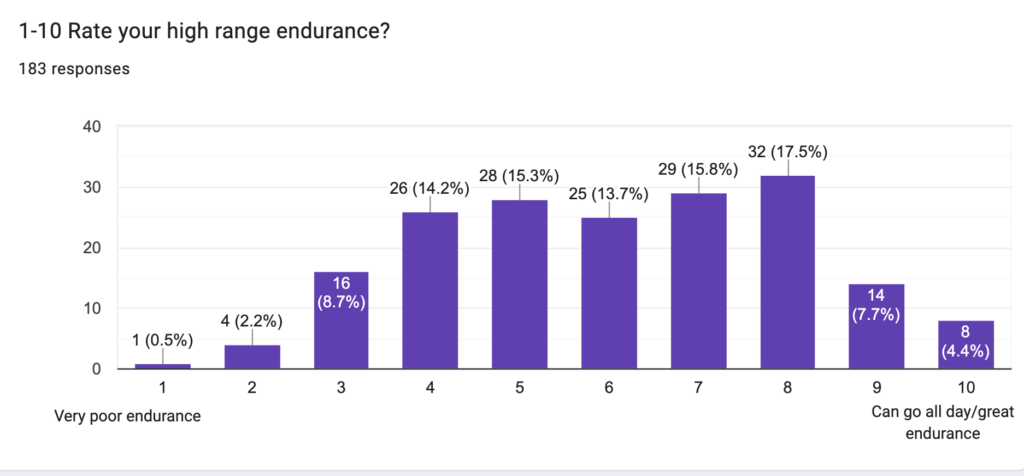
Endurance, a much more normal curve...
I asked "1-10 Rate your high range endurance".
42% of folks were square in the middle (a 4,5, or 6 on the scale 1-10).
And then another 45% were in the upper bracket (great!)
And only 11% are in the lower bracket. Meaning probably 1 in 10 of respondents REALLY struggles with endurance.
This sounds about right to me.
41% of players here ranked a 5 or below.
That reflects less extreme problems.
Maybe it's the kind of player that generally does ok but would struggle to crank out the high horn part finishing Mahler 1...
Based on my experience playing in professional (and amateur) orchestras over 3 continents, I'd wonder.... if being able to successfully play the high horn part of Mahler 1 without endurance-induced failures is a mark of having good endurance, can 60% of players do that?
Maybe? I think these stats are pretty ballpark, actually.
High range endurance rankings for 183 French hornists
#StruggleLife
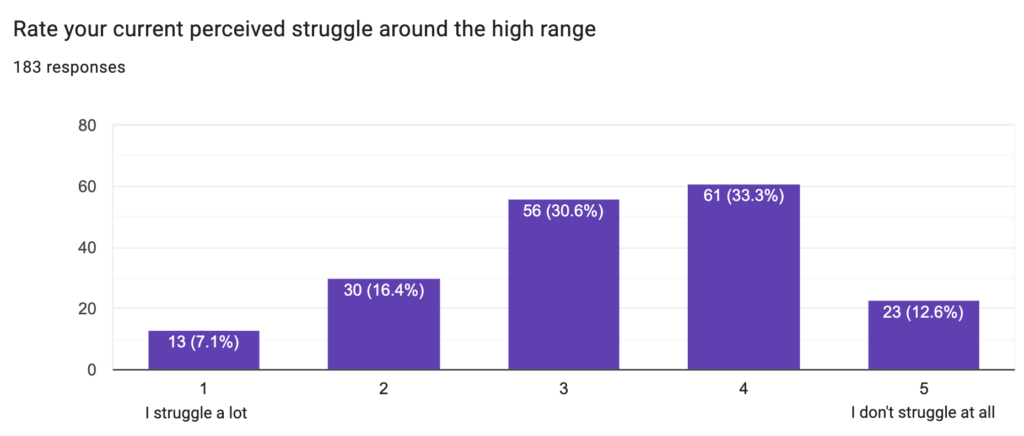
I asked two questions to find out the impact and prevalence of high range struggles.
23.5% identified as struggling
30.6% were in the middle
45.9% identified as not really struggling
Perceived struggle w/ high range, 183 French horn players
This also matches my intuition.
About 1/4 of folks have some level of struggle with the high range.
Four horn players in a section, probably one of them has high range difficulties. cough cough 4th horn players....
Well that's legit. When I played 4th horn in the Hong Kong Philharmonic I was definitely barely able to meet the call of duty in occasional high tuttis.
(And fast-forwarding, thanks to numerous sources of help, wisdom, and healing, I got over that).
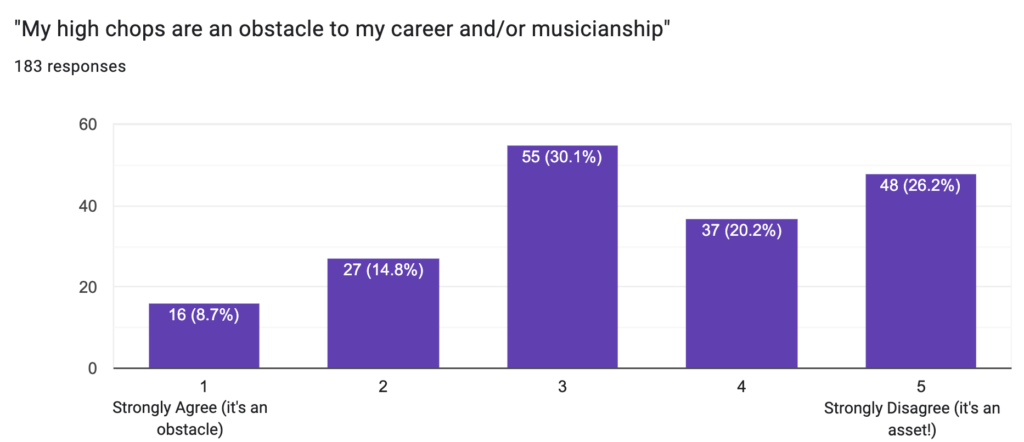
Make sure you read this chart correctly. 5 is "strongly disagree".
So 8.7% of players (again almost 1 in 10) really feel that their high playing is a huge obstacle.
And only 46.4% actually disagree with the statement.
That means that more than half of players believe that their high chops are some kind of obstacle in their career and/or musicianship.
What a bummer!
The good news
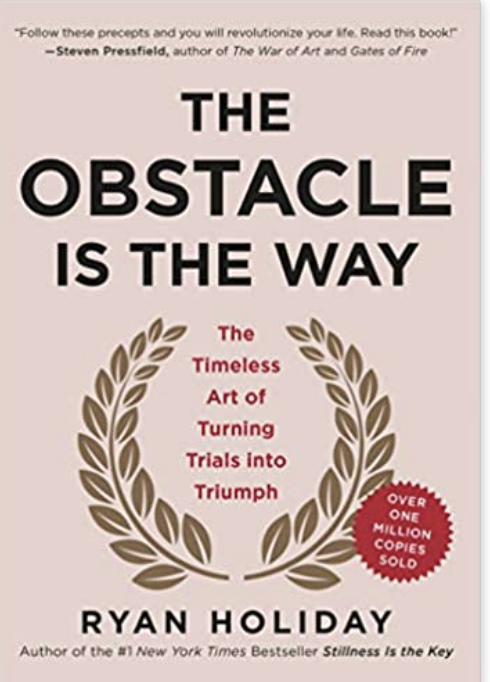
To quote Ryan Holiday, "The Obstacle is the Way"... it's a best-selling book title for a reason!
If you have high range issues, this is the obstacle that points the way forward in your musical development.
There are easy and effective strategies for mastering the high range, no matter what the shape of your lips.
And the best time to start making those changes... is now. (Well, actually the best time would have been when you started playing horn. But the 2nd best time is now).
What can I do?
I created a 25 minute video masterclass on high playing that you can watch for free here:
These are "upgrades" that make your normal practice that much better, no matter what instrument/voice or style.
CREATIVE TRANSFER
Keep on tap some tracks of artists who inspire you!
Keep your aesthetic world expanded during practice by interleaving these inspirations.
Videos can be great because you can learn from their physical posture, playing technique, facial expressions, etc.
Audio can be great if you want to focus on how it sounds and feels.
Don't just be inspired: CREATIVELY TRANSFER.
The simplest example is 1:1 - find an artist who is playing a piece that you're working on, and literally just impersonate them.
Play their exact licks, their exact phrasing.
Or, just listen to their tone, articulation, emotion... transfer it to something totally different.
Become more and more a SOUND ARTIST.
My application: Baroque violin to scales. Sheherezade horn section
PERFORM & EVALUATE SEPARATELY
If you're evaluating how you're doing, that's very left brain, analytical, and focused on the past, and generally critical.
It's not a great mindset to be in when you're performing.
When you're performing it's best to be focused on the present & very near future, "full brain" - left brain is operating any technical stuff, and right brain is generating musical/emotional attunement.
You want to practice being in the most effective mindset.
That means when you are playing your instrument, focus on performing!
Use a recorder - video or audio - to record your performance. Then listen back and analyze.
Make a list of all the things you'd like to celebrate or fix.
Often, things will converge into a single, simple solution for improvement.
You can only half-ass your self-evaluation while in the midst of playing or singing.
You can only half-ass your performance while in the midst of self-evaluation.
So do them both fully, by separating performing & evaluating.
USE BACKING TRACKS, NOT METRONOMES
Have you listened to a metronome lately?
It freaking sucks!
It's unmusical.
The difference between metronome click & backing track is that a typical metronome doesn't have phrasing, nor artistically satisfying subdivision or internal patterning.
You can find pure percussion backing tracks, like these:
DILLA BEATS DRUM GROOVE
FAST METAL 140BPM
GROOVY DRUMS 90BPM
or get interesting with
9x4 TAKE-TATAKE-TAKETINA LOOP
They are far more interesting than a metronome and will invite more musicality, phrasing, and precision (due to engaging subdivisions).
I like using these for scales, arpeggios, flexibilities, and more.
WHAT ARE YOU WAITING FOR! GO GET IT
... or post your favorite practice upgrade below
Your "vibe" determines what you can see
I recently revisited a journal entry of mine, and it illuminated an important concept.
How you feel, your inner state, has a huge impact on what you see.
In my case, exactly what I needed.... was hiding for me in plain sight... until I cleared some heavy emotions.
...
I had just landed in beach paradise Mazunte, Mexico (now sadly destroyed by a recent hurricane).
After a challenging day, I wasn't feeling hungry but I thought I should feed myself before ascending a long steep hill to my hotel.
Pizza called.
It's not the kind of food that helps me with cellular vitality, gut health, and athletic performance.
I felt nigh the slice of reality in which I got pizza and negative spiraled my day further.
Instead of indulging, I sat down and journaled on my feelings & needs.
There was a lot going on!
Lots of needs.
Note to future self: next time include met needs too, for a positive spin.
After journaling, I still felt a craving to drown my discomfort in pizza.
I had the presence of mind to pull out a vibrational scale. I was at the total bottom. It took maybe five minutes but I got to a point where I felt in love with myself and life again.
Finally, I saw some musicians going into the beachside gourmet pizza restaurant, to play a set for the patrons. A lovely sign from the universe?
I see this as masterful: Even holding my dreams & goals, knowing pizza is not aligned but there might be some interaction or other experience to be had, I went into the pizza parlor. The lion's den.
And there was salad on the menu... but no seats.
So I left. I walked.
Nothing called to me, so I trusted the unfolding and kept walking.
Finally, I decided to sit for a 4 minute "fuck yes" meditation.
That's where you just say "fuck yes fuck yes fuck yes" over and over in your mind, and greet everything with open armed "fuck yes" enthusiasm.
I followed my nose to the empanada restaurant I had passed by 5 times already - decidedly not the food for me, only to find another restaurant hidden within!
And this restaurant, "Umami", had farm to table bowls featuring local caught fish and delicious greens.
Food that would fuel my dreams.
I sighed in relief, smiled at the way physical reality seems to shift when we change our internal state. I had walked past this restaurant so many times and it was invisible before I changed my vibration.
This is the problem with staying too long in victim stories, in letting your reactions become moods and then identities.
An entire world of possibility awaits you; but it's not even visible when you are in a bad enough mood.
Shift your internal state, and the right path becomes obvious.
Drop Your Weapon
[today's practice tip works for musicians AND anybody who uses a computer]
I challenge you to free your hands right now.
Take them off your computer or phone.
Rest your hands by your side or on your lap.
And notice what happens.
..... ahhhhhhhhhh...... isn't that nice?
When you're practicing or working, try doing a brief 5 to 20 second physical reset in between repetitions.
I first learned this from Stuart Fuchs who has a "1 note" practice at his ukelele:
- Play one note.
- Take the hands off.
- Feel what just happened, integrate it.
- Repeat.
This kind of patient, restful approach feels very different from the rushed, often mistake-laden practice I've heard from musicians across the world... even respected pros.
(Sometimes success comes not because of a way of practicing, but in spite of a way of practicing)
Learning takes time!
A little bit of space and physical rest in between repetitions is a very smart way to support learning.
"Go slow to go fast"
I dare you Let me know how it goes.
OTHER BENEFITS:
- resting your mind keeps it fresh
- reset the body to avoid repetitive strain
- come back to center
- gives you many more "first notes", overcoming the common anxiety point around picking the instrument up and beginning to play
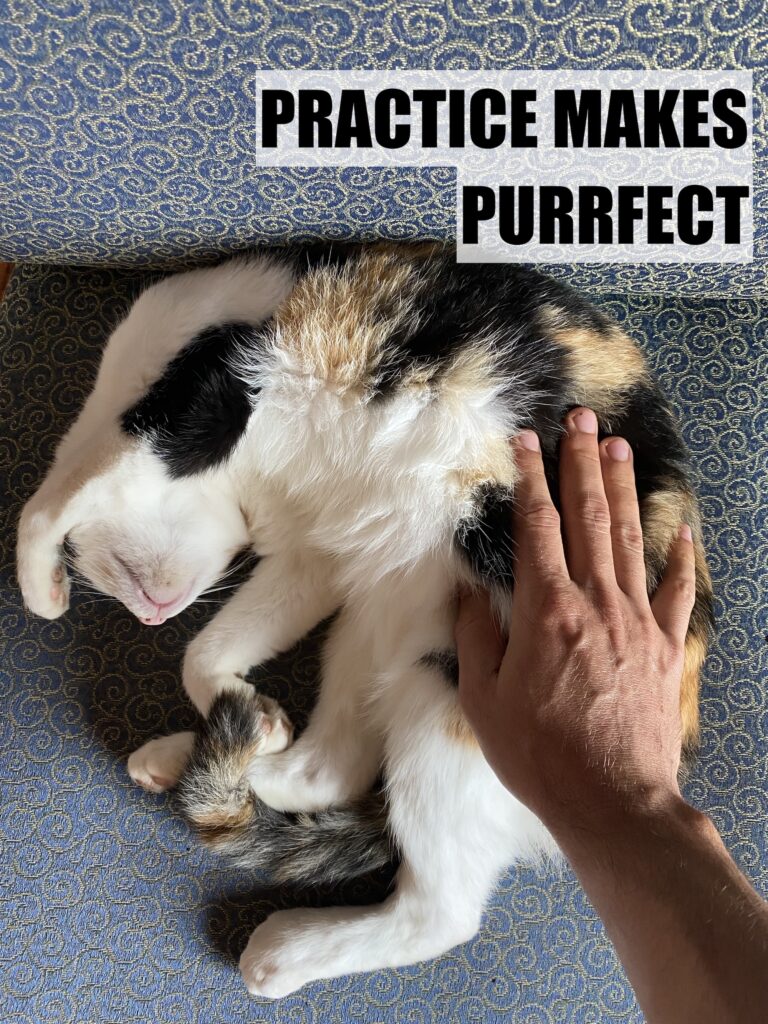
- you'll feel like the happy relaxed kitty in the photo

 CREATIVE TRANSFER
 PERFORM & EVALUATE SEPARATELY
 USE BACKING TRACKS, NOT METRONOMES
 WHAT ARE YOU WAITING FOR! GO GET IT
 When you're practicing or working, try doing a brief 5 to 20 second physical reset in between repetitions.
 Let me know how it goes.